My 2nd Line Text Call Number
- 4.4
- Rating
- 1.00M
- Installs
- Free
- Price

 Analysis by App-foxy
My 2nd Line Text Call Number is a communication app built around a simple but useful idea: keeping a second phone number separate from the one people already use to reach you. I found that distinction more important than the extra number itself. It can change when I answer, which conversations I prioritize, and how clearly I separate personal contacts from practical or public-facing communication.
The app is free to download, carries an Everyone age rating, and comes from AutoBizLine, Inc. Its store summary presents it as a second line for private texts and calls, while the short description uses the name My 2nd Line. With an average rating of 4.4 from around twenty-two thousand ratings and more than one million installs, it has clearly attracted a substantial audience. The current release is version 1.3.15, and it works on Android 7.1 or later.
A second number can make communication easier to manage
I think the strongest reason to try this app is not that people need more ways to talk. Most of us already have too many. The real need is separation. A personal number often ends up being used for family, friends, deliveries, local services, short-term projects, marketplace conversations, and people I may not want contacting me indefinitely. Once those uses mix together, every incoming call feels equally urgent even when it is not.
You May Also Like

 Blood Strike: 2.5 Anniversary
Blood Strike’s Loadouts Turn Every Drop Into a Tactical Gamble
A close look at Blood Strike’s custom loadouts: how fast access to signature weapons reshapes its battle royale rhythm, rewards preparation, and narrows the gap between fights.

 Pandora - Music & Podcasts
Pandora’s Music Is Easy to Start, but Harder to Recover
Pandora’s strength is its low-effort path from a seed to a station. Its weak spot is how much confidence it asks you to place in connection, setup, and quiet recovery.

 8 Ball Pool
 Is Built on Rivalries, Rematches, and Routine
A close look at the rivalries, rematches, shared routines, and unanswered safety questions that turn a quick pool match into a persistent mobile community.

 Samsung Music
’s Quiet Strength Is Playing What You Already Own
Its reach comes less from spectacle than from dependable access to a personal library. That simplicity is both the app’s strongest retention engine and its ceiling.

 AccuWeather: Weather Radar
AccuWeather Review: A Quick, Clear Forecast for Everyday Decisions
For everyday plans, the best forecast is the one you can understand quickly. AccuWeather makes rain timing, radar, and local conditions easy to act on, with a few trade-offs.

 Hill Climb Racing
Why Hill Climb Racing Still Turns Crashes Into One More Run
A tiny car, a bumpy hill and one more upgrade: Hill Climb Racing keeps resurfacing because its simple chaos makes every near-miss feel personal.
More From Our News Desk



A second line gives those conversations their own place. I can use it for a small business, a side project, apartment inquiries, online selling, event coordination, or any situation where I want to be reachable without handing out my main number. That separation also makes it easier to change my communication habits. Instead of checking every message with the same expectation, I can treat the second line as a specific channel with a specific purpose.
This is where My 2nd Line Text Call Number feels more practical than a basic messaging app. A chat service usually depends on the other person using the same service. A second-number app is more useful when I need a phone-style contact point for people who may simply call or text normally. That makes it a better fit for mixed groups, casual contacts, and situations where asking everyone to install another app would create unnecessary friction.
There is also a privacy advantage, although I would describe it as a layer of separation rather than complete anonymity. Giving someone a second number means I do not have to expose the number tied to my closest contacts. That can reduce future interruptions when a temporary conversation becomes less temporary than expected. I still need to use sensible judgment about what I share, but the extra line gives me a cleaner starting point.
Where the extra line fits in everyday life
A realistic example is selling furniture or electronics locally. I might want buyers to call or text while an item is available, but I may not want those conversations mixed with family messages. Using the second line lets me keep pickup details in a separate stream. When the sale is finished, I can stop treating that line as part of my everyday social life instead of having strangers continue to reach the number everyone close to me knows.
The same pattern works for freelance inquiries. I can place the second number on a profile, a printed card, or a message to a potential client, then keep personal calls on my regular line. This does not replace a full business phone system, but it can be a sensible middle ground for someone testing an idea or handling a modest number of contacts.
I also see value for people who frequently arrange appointments, coordinate volunteers, or participate in community groups. These conversations often matter, but they do not need to interrupt personal communication all day. Assigning them to a separate line makes the purpose of each conversation clearer before I even read the message.
How the conversation flow feels in practice
The useful change is the mental flow around a conversation. On a single number, a message from a close friend and a question from a stranger can arrive beside each other, demanding the same glance and creating the same notification pressure. With a second line, I can decide that one channel is for immediate personal communication and the other is for conversations I will review in blocks.
That does not automatically make me more organized. The app cannot decide which contacts deserve a reply or prevent me from checking both lines constantly. What it does is create a boundary I can actually follow. I can tell people, “Use this number for the project,” and then keep that project from spilling into every personal conversation.
One practical workflow is to assign a clear purpose before sharing the number. If I use it for work inquiries, I should keep it for work inquiries rather than gradually adding shopping, dating, neighborhood, and family contacts. The more consistent the purpose, the more useful the separation becomes. A second number with no defined role quickly turns into another crowded inbox.
I would also recommend introducing the line in plain language. Telling people that it is the best number for a certain type of request helps them understand when to use it. That small explanation reduces duplicate messages across both numbers and prevents the common problem of answering on one line while the important context sits on the other.
For ongoing conversations, the second line can improve clarity because the setting itself provides context. If I open it expecting client questions, I am less likely to confuse a delivery update with a personal plan. That sounds minor, but context switching is one of the hidden costs of modern communication. The app is most helpful when I use the separate line intentionally rather than simply treating it as a spare number.
Calls and texts serve different rhythms
The app’s focus on both calls and texts matters because people do not communicate at one speed. A call asks for immediate attention, while a text can often wait. A second line lets me decide which kinds of conversations belong in that channel, but I still need to think about how I want to respond to each one.
For example, I might use the line for appointment coordination where texts are convenient and calls are reserved for urgent changes. In another situation, such as a small repair service, calls may be more useful than long message threads. The best setup depends on the people contacting me, not just on the existence of the number.
This is also why I would not hand out the second line indiscriminately. If every low-priority contact receives it, the line becomes noisy and loses its value as a focused channel. I get better results when I treat it like a reception desk: open enough to receive useful requests, but not so broadly shared that every conversation becomes permanent background noise.
The attention cost: a second line is not a second brain
The main limitation is easy to overlook. A second number can separate conversations, but it can also create another place to monitor. If I already struggle with notifications, adding another communication channel may increase the feeling that I must always be available. The app helps only when I use the separation to reduce attention, not when I use it to accept more interruptions.
Before setting it up, I would decide what deserves immediate attention. If the second line is for non-urgent inquiries, I should make it part of a scheduled check rather than reacting to every alert. If it is for time-sensitive coordination, I may need to keep a closer eye on it. The important point is to choose the rhythm first; otherwise the new line chooses it for me.
There is a subtle psychological benefit to keeping the purpose narrow. When I know that the line is mostly for one kind of conversation, I can scan it faster and make decisions with less mental effort. I do not need to reconstruct why a person is contacting me every time. The number itself becomes a small piece of metadata.
However, this advantage disappears if I use the line for too many unrelated roles. Someone considering the app should ask whether they want separation or simply more capacity. If the goal is to handle a large operation with several staff members, shared access, records, and formal customer management, a dedicated business phone platform may be a better choice. This app is more convincing for individual use and lightweight communication needs.
Another trade-off is continuity. A second line is valuable only if I remember to keep it available for the people who rely on it. If I stop checking it, contacts may assume I am ignoring them. I would therefore choose a line purpose that matches my actual routine. A number for occasional inquiries is sensible if I can review it regularly; it is a poor choice for urgent support if I cannot.
Small habits that make the separation work
I found three habits especially useful. First, I would write down the exact reason for the line before sharing it. “Marketplace sales” is clearer than “miscellaneous contacts,” and that clarity makes future decisions easier.
Second, I would keep the number out of personal group conversations unless there is a real reason to mix the channels. The value comes from preserving context. Once a personal group begins using the second line casually, the distinction becomes harder to maintain.
Third, I would review old conversations and contacts from time to time. A temporary project can leave behind people who no longer need access. Removing those relationships from my active attention is part of using a second line well, even if the app itself is not a full contact-management system.
These are not flashy tricks, but they are the difference between a genuinely useful communication boundary and an extra inbox. The app provides the channel; the user has to provide the rules.
Privacy, boundaries, and the situations where I would skip it
I like the privacy logic of not giving my primary number to every person who needs to reach me. It is especially useful when I want to keep a conversation possible without making it part of my permanent personal network. A separate line can make saying “contact me here for this matter” feel more natural and less confrontational.
Still, I would not treat the app as a guarantee that every interaction is private or risk-free. A second number does not remove the need to avoid sensitive information in casual messages, recognize suspicious requests, or think carefully before returning an unknown call. It creates distance between channels, not immunity from unwanted communication.
I would also be cautious about using it as the only number for something critical. If a service, account, or important relationship depends on reliable long-term access, I would first make sure the arrangement fits that purpose. The app is attractive for flexible, everyday communication, but essential contact details deserve a more deliberate backup plan.
The cost structure is another point to understand before committing. The app is free, but in-app purchases range from ninety-nine cents to four hundred dollars per item. That wide range means I would inspect the available options carefully inside the app and avoid assuming that every useful capability is included at no cost. The free entry point is appealing, yet anyone planning to depend on the service should understand which parts of their intended use may involve purchases.
For a person who only wants one occasional number for a short project, this may be enough. For someone who needs a polished company identity, multiple users, formal call routing, detailed records, or strict administrative control, I would look at a business-focused alternative instead. Likewise, someone who only wants private messaging with a small group may prefer an end-to-end chat service where everyone communicates inside the same app.
The choice depends on the communication problem. If the problem is “I need another place for calls and texts from people who may not share a messaging platform,” this app makes sense. If the problem is “I need a complete customer-service operation,” it is probably too small in scope. If the problem is “I need fewer notifications,” the app can help only if I use the second line to limit attention rather than expand it.
My social verdict after living with the idea
What I appreciate most about My 2nd Line Text Call Number is that it addresses a social problem rather than merely adding a technical option. The problem is that one phone number often carries too much meaning. It represents family, identity, availability, work, transactions, and access. A second line lets me decide that not every conversation deserves the same route into my life.
That can improve communication rhythm. I can answer personal calls as personal calls, review practical messages when I have the right mindset, and give temporary contacts a clear way to reach me without making them part of my closest circle. The benefit is less about having another number on screen and more about making the purpose of a conversation visible from the start.
The app has earned a 4.4 average and has passed one million installs, which makes it an established option rather than an obscure experiment. It is free to start, rated for Everyone, and its Android compatibility reaches back to version 7.1. Those details make it accessible to a broad range of users, although the in-app purchase range means I would still check the cost of any feature I plan to rely on regularly.
My recommendation is strongest for freelancers, sellers, organizers, renters, side-project owners, and anyone who regularly needs to be reachable without exposing a primary number. I would also recommend it to people trying to create healthier communication boundaries, provided they are willing to set a checking routine and keep the line focused.
I would skip it if I already have a reliable second-line service through my carrier, if I need a full business phone system, or if another messaging platform already gives my group the privacy and separation I want. I would also skip it if my real problem is notification overload and I know I will monitor two lines compulsively.
For the right user, though, this is a practical communication tool with a surprisingly human benefit: it makes it easier to be reachable without being universally available. That distinction is valuable. A second line will not solve every problem around attention and privacy, but used with clear rules, it can give everyday conversations a cleaner rhythm and a more comfortable boundary.
FAQs for My 2nd Line Text Call Number
01What is My 2nd Line Text Call Number used for?
My 2nd Line Text Call Number provides a separate phone number for calling and text messaging alongside your primary mobile number. It can be useful for business contacts, online selling, dating, travel, or keeping personal conversations separate. The app is designed to work through an internet connection, so availability and call quality may depend on your Wi-Fi or mobile data connection.
02Can I choose my own second phone number?
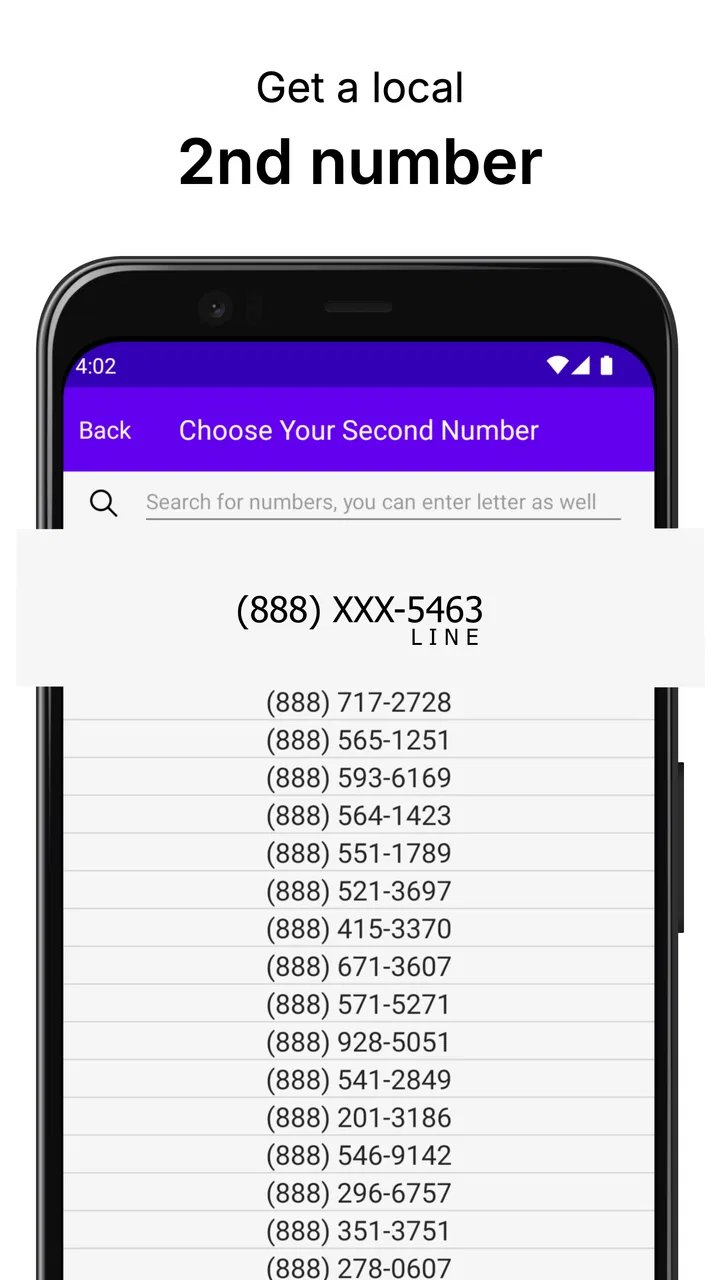
The app generally allows users to select or claim an additional number from the locations and options available during setup. The exact choices may vary depending on your country, account status, and current number inventory. Before downloading or subscribing, check whether numbers are offered in your preferred area and review any rules about number retention, expiration, or account inactivity.
03Does My 2nd Line Text Call Number require a subscription or charge for calls and texts?
The application may offer free features, in-app purchases, or subscription plans depending on the service and your region. Some functions, such as premium numbers, extended calling, international communication, or removing limitations, may require payment. Carefully review the pricing shown in the app store and inside the application, including renewal terms, trial periods, and cancellation instructions, before confirming a purchase.
04Can I use the app without Wi-Fi or mobile data?
Because My 2nd Line Text Call Number relies on internet-based communication, you normally need Wi-Fi or mobile data to send messages and place or receive calls. It is not the same as a traditional cellular line, even though it provides a separate number. Using mobile data may consume part of your plan, while weak connections can cause delays, dropped calls, or reduced audio quality.
05Is my second number private and suitable for business or personal use?
A second number can help protect your primary number by keeping it separate from contacts, customers, marketplaces, or online services. However, it should not be treated as complete anonymity or guaranteed security. Review the app’s privacy policy, permissions, data practices, and account recovery options before sharing sensitive information. For business use, also verify whether the number supports the verification and calling features you need.
Pros
- Provides a separate number for calls and texts without changing your primary SIM.
- Useful for keeping work
- personal
- and online contacts separate.
- Voicemail features help manage missed calls when you are unavailable.
- Can be convenient for temporary communication or classified listings.
- A familiar calling interface makes basic communication easy to manage.
Cons
- A reliable internet connection may be required for consistent calling quality.
- Number availability can vary by country
- area code
- or subscription plan.
- Some recipients may not recognize or trust calls from a secondary number.
- Advanced features and longer-term number access may require payment.
- Emergency calling support may be limited compared with your carrier number.

My 2nd Line Text Call Number
Gallery